The ticket that arrived at 8:47
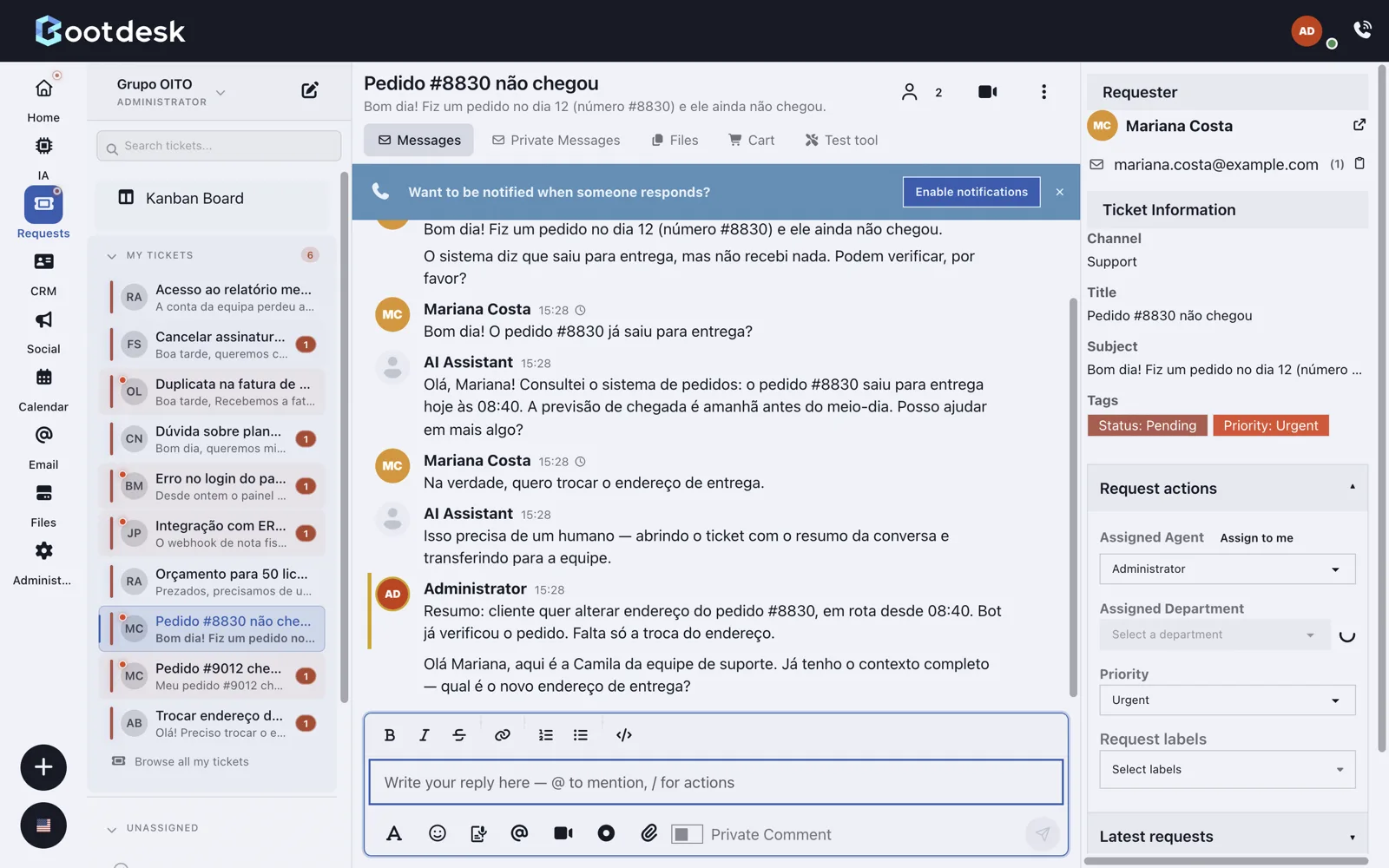
A customer writes on WhatsApp: “Order #8830 hasn't arrived”. In a traditional helpdesk, that sentence becomes an empty ticket — a number, an irritation, and an agent about to ask questions the customer has already answered three times.
In BootDesk, the assistant opens the ticket and does what a good agent would do with a cup of coffee: reads the history. What was promised, what was already tried — and that this is the third time this customer has written in. Then it drafts the reply, with the story attached.
View the callsHide the calls
lookup_order — ERP · order #8830knowledge_base — delivery-policy.pdfopen_ticket — queue · support-tier-2Look it up, don't guess
The difference between a useful assistant and a canned-response chatbot is what happens before the first word. The BootDesk assistant works with sources, not hunches: the full thread, your knowledge base, connectors you attach, and — where you allow it — the live web.
Every lookup appears in the ticket as a visible card. No black box: if the draft says the order shipped Tuesday, you can see exactly where it read that.
The quiet handoff
And when the conversation needs a person? The assistant doesn't pretend to be what it isn't. It summarizes the context, flags what it already tried, and hands the ticket to your team — with the boring work done. The agent joins knowing the customer's name, the history, and the state of the conversation. And while it holds the conversation, it never plays human: it is the assistant, and it says so.
Automation that doesn't know when to stop isn't automation — it's neglect with scale.The rule the product is built around
A colleague for your team, not just for customers
Inside support, the assistant is one more name on the board — literally. Put an assistant on your work board and it takes tickets, does the legwork, and moves the card to review for a human to approve. Mention it with @ anywhere — a thread, a ticket, a deal — and it answers with your data in view.
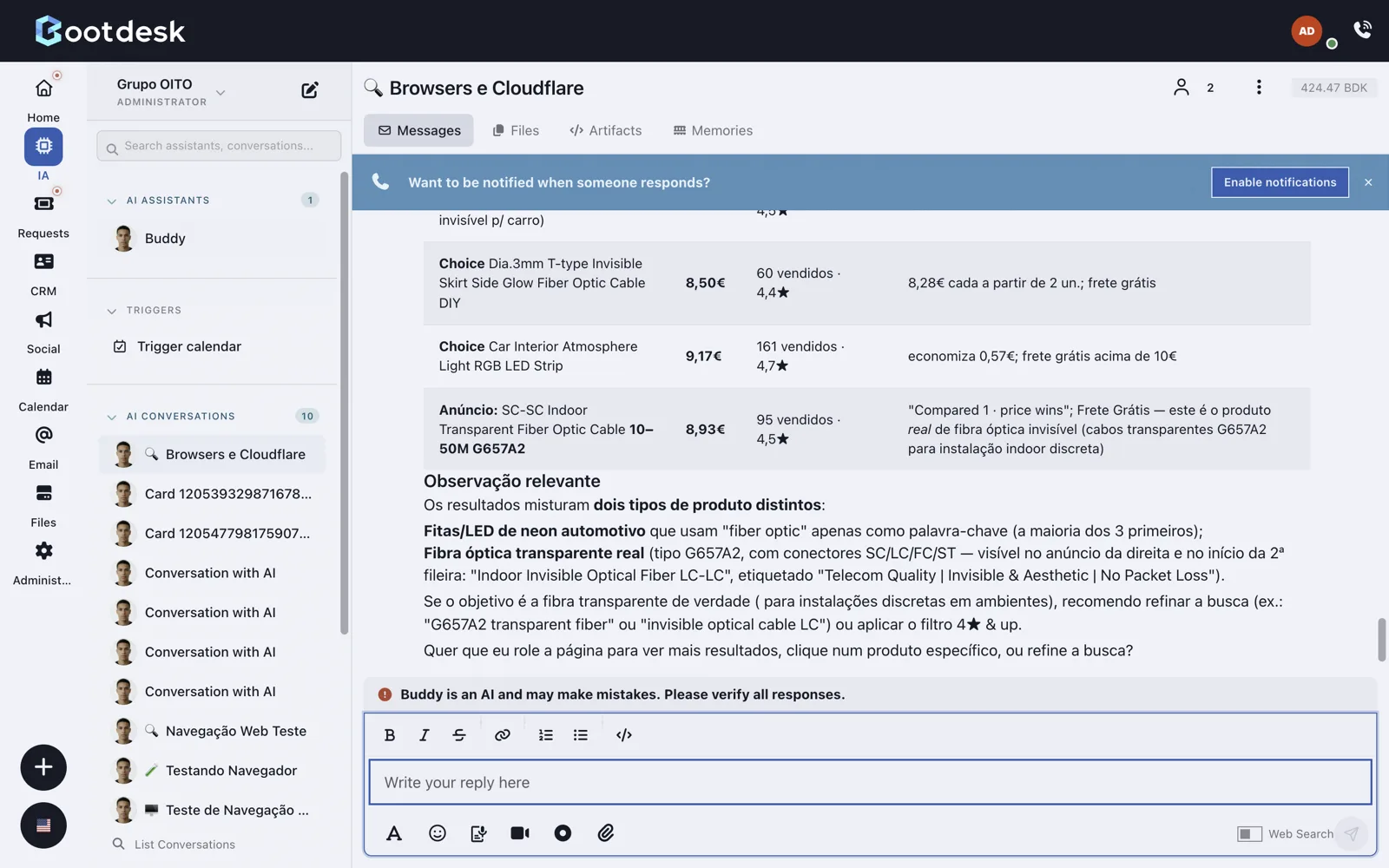
Ask in plain language: “which tickets have been open more than three days?”, “summarize the support week”. The screen below is the real workspace: a work conversation with the assistant, in the same place the team resolves tickets. No new tab, no parallel tool.
The work it does while you do yours
The same assistant that works the queue works for the team. The open web it fetches fresh from our servers; the parts behind a login belong to your browser, and there is a section below about that. It reads the documents your business actually runs on: presentations, contracts, spreadsheets, PDFs. And it writes back in kind — decks ready to present, spreadsheets with working formulas and charts, properly formatted documents, rich PDFs. It can generate images and plan a week of social content in your voice. The deliverables land in the thread, next to the sources they came from.
Pick a constellation, not a model
Every AI product wants you to become a model connoisseur — benchmarks, context windows, price per million tokens. That is our job, not yours. BootDesk ships constellations: curated sets of models and settings, tuned per task and maintained by us. You never pick a model; you pick the work. When a better model lands, the constellation updates and the work just gets better — no migration, no re-engineering. Intelligence is a commodity now; the value is in what it is pointed at, and in the price line you can audit.
It drives a browser, not just a chat
Some work lives behind a login — the supplier portal with no API, the order dashboard, the internal wiki. Our servers can't reach those, by design: they don't have your session, and they have no business on your intranet. Your browser does. Install the extension for Chrome or Firefox, or the desktop daemon that sits quietly in your system tray, and the assistant drives your own installed browser: logged in as you, seeing what you see, reaching what your network reaches. The steps show up in the thread like every other card.
What this changes on Monday
It changes the queue. The repeat questions — order status, duplicate invoice, opening hours — stop being tasks and start being conversations the assistant carries: answering directly where you put it in front of customers, drafting for a human where a human owns the ticket. What reaches your team is the work that deserves one: negotiation, exception, empathy.
Either way, the customer always knows who they are talking to. That's not a limitation we hide — it's the design.